
New Construction Hidden Costs in Florida: What’s Really Underneath
The advertised price is just the beginning. Here’s how Florida new construction pricing actually works — five layers most buyers don’t see until it’s too late.

You’ve found the community. The model home looks incredible. The price feels manageable. But the number on that sign? It’s the tip of the iceberg.
I break down how market conditions, interest rates, and local trends actually impact buyers and sellers across Florida’s Gulf Coast — without the hype.
If you want a clearer framework to help you make smarter decisions, you can start here:
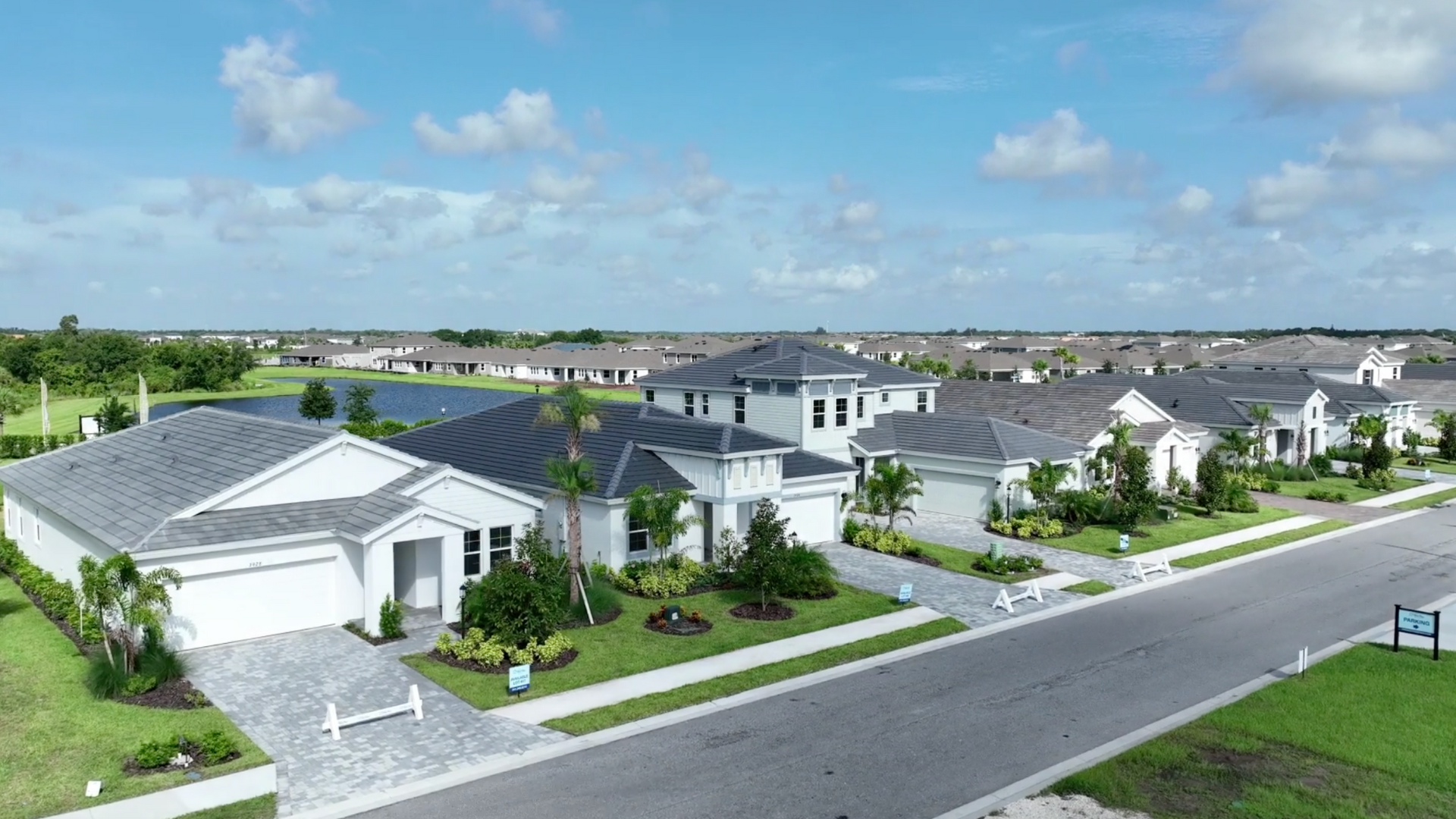
When you pull up a community online and see a home listed at $420,000, two words follow that number almost every time: “starting from.”
That phrase is doing a lot of work. What it really means is that a formula is about to apply — and most buyers don’t see the formula until they’re already sitting across from a sales rep.
The advertised base price covers the basic structure and whatever the builder calls “standard.” Standard, in most production communities, is far simpler than what you saw in the model home. Those model homes carry every upgrade the builder offers. The base price home looks nothing like them.
That gap between what you toured and what you’re actually pricing out is where most budget surprises begin.
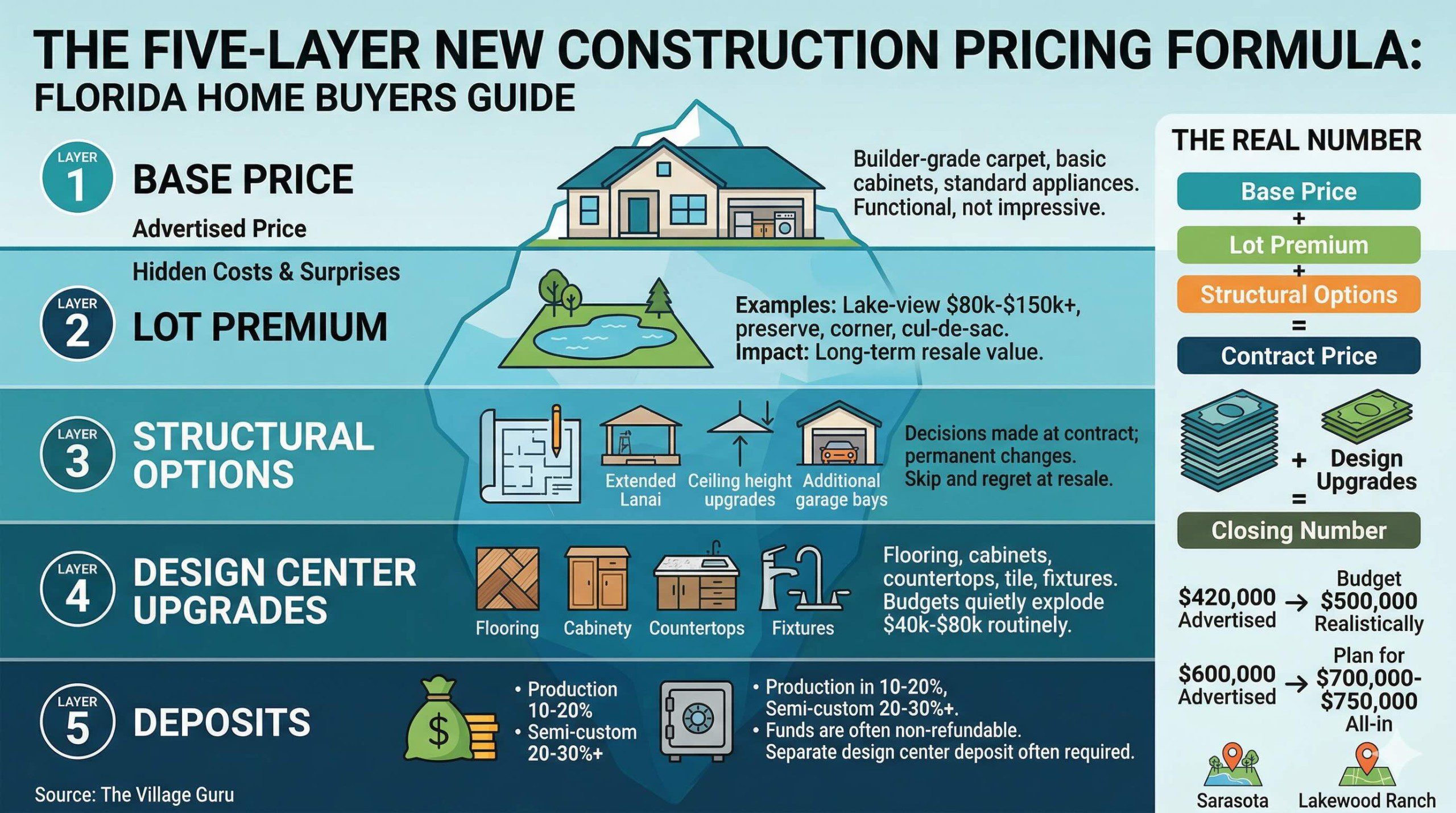
Here’s how new construction pricing actually works. Once you understand the formula, the math becomes predictable, and the surprises stop.
This is the number on the sign. It covers the basic floor plan and builder-standard finishes. Think builder-grade carpet, basic cabinets, standard appliances. Functional, not impressive.
Not every lot in a community carries the same price. A lake-view lot in a Lakewood Ranch community can add $80,000 to $150,000 over a standard interior lot. Preserve-backing lots, corner lots, and cul-de-sac positions all carry their own premiums.
Here’s what most buyers underestimate: the lot you choose has more direct impact on your long-term resale value than almost any upgrade you make inside the home. A great lot in a strong community holds its value. Upgraded flooring does not.
This is the layer where the biggest mistakes happen, because the decisions feel low-stakes in the moment and they are permanent.
Structural options include things like extended lanais, ceiling height upgrades, impact windows, expanded kitchens, and additional garage bays. You make these decisions at contract — once construction begins, they cannot be changed.
You get one shot. Buyers who skip structural options to save money often regret it at resale, because future buyers price those missing features right back into their offers.
This is the fun part — flooring, cabinetry, countertops, lighting, tile, fixtures. This is where your home becomes yours. It’s also where budgets quietly explode.
Each individual upgrade seems manageable. A flooring upgrade here, a cabinet upgrade there. However, together across an entire home, they add up fast. Buyers who go in without a hard number and a clear priority list routinely spend $40,000 to $80,000 in the design center.
The Ultimate Guide to New Construction Homes covers design center strategy in detail, including what to prioritize for resale value and what to skip.
New construction deposits run significantly higher than resale. Production builders in the Sarasota and Lakewood Ranch market typically require 10 to 20 percent. Semi-custom and custom builders often require 20 to 30 percent or more.
On a $600,000 home, that means having $60,000 to $180,000 in cash available before the home is built. In most cases, builders hold those funds as non-refundable once you sign and wire.
Many builders also require a separate deposit at the design center to cover your upgrade choices. Builders typically require those funds fast. The last place you want to be is scrambling to move money on a deadline you didn’t see coming.

When you stack the five layers, the math clarifies fast.
Base price plus lot premium plus structural options gives you your contract price. Add design upgrades and you have your closing number. Because of how these layers compound, it’s not unusual for buyers to end up 15 to 25 percent above the advertised starting price by the time they close.
That $420,000 home? Budget for $500,000 and you’re closer to reality. At $600,000 base, plan for $700,000 to $750,000 all-in before financing.
This isn’t a criticism of the builders. It’s just how the process works. The buyers who understand it going in make better decisions at every stage. The ones who don’t are the ones calling me two years later wondering why their resale is harder than expected.
I want to share two real situations, because the difference between them says more than any formula.
A couple relocating from out of state. Sharp people. They’d done their research — watched videos, read about communities, understood the general market. They found a neighborhood they loved, toured on a Saturday, fell in love with the model, and signed Monday morning.
What they missed: the lot they chose backed onto land zoned for future commercial development. The structural options they passed on — the extended lanai, the higher ceilings — locked in at signing and couldn’t be revisited. And the builder incentives they accepted came with conditions that limited their flexibility when rates shifted.
Still, none of those things ended the deal. They love the home. But when they came back to me three years later ready to sell, every one of those choices showed up in the numbers. The lot put them at a disadvantage. The missing structural options were priced in by buyers. The resale was harder than it needed to be.
They didn’t make bad decisions. They made uninformed ones. In new construction, those tend to end up in the same place.
Different couple. Same market. Similar budget. Before they toured a single model, we mapped the complete financial picture — every layer of the formula. We defined which communities fit their lifestyle and daily schedule, not just which ones had the nicest models. We identified the structural options worth spending money on for their specific floor plan. We built a design center number before they walked in.
By the time they sat down with a sales rep, they weren’t reacting. They were positioned. They knew which lots to ask about and which to skip. They knew exactly what the structural upgrade list looked like before the rep handed it to them.
As a result, they closed on a home they love, in a community that fits their life, with a resale position they feel confident about. The difference wasn’t luck. It was strategy, and having it before they were in the room.
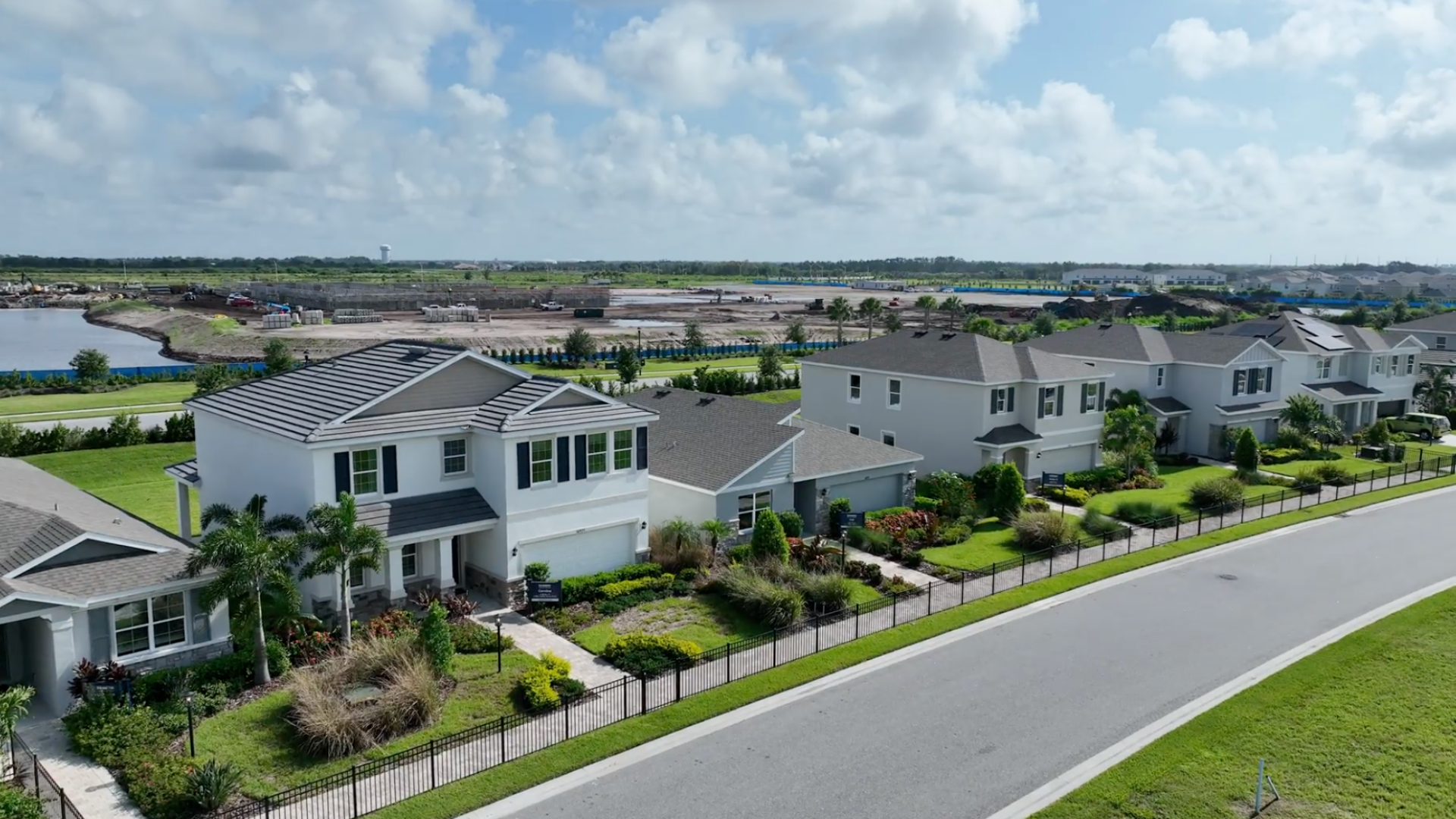
New construction in Sarasota and Lakewood Ranch is one of the best opportunities in this market. The communities here are outstanding. The builders are experienced. The product is genuinely good.
But the process is designed for buyers who know what they’re doing. The sales center environment moves fast, the decisions feel low-stakes in the moment, and the contract protects the builder — not you.
None of that means walk away. It means come in prepared.
If you’re evaluating communities and trying to understand how costs compare across different builders and price points, these posts will help you think through it:
If you’re actively touring communities or getting close to a decision, the single most useful thing you can do before you commit is slow down for a conversation.
A strategy call isn’t about figuring out whether to buy. It’s about making sure you’re walking into that sales center with the full picture — your real budget mapped across all five layers, the communities that fit your actual life, and a clear read on where the negotiating leverage actually sits.
It’s a second opinion before a six-figure decision. That’s all it is.
Book a Strategy Call
The biggest surprises are lot premiums (which can add $80,000 to $150,000 on a lake or preserve lot), structural upgrade decisions that lock in at contract signing, design center costs that stack quickly across a whole home, and deposit structures that require 10 to 30 percent in cash before construction begins. Together these routinely push the final price 15 to 25 percent above the advertised starting price.
It depends on the builder, the phase, and current inventory levels. Production builders like Pulte and Neal Communities have limited flexibility on base price but frequently offer incentives on closing costs or design center credits. The key is knowing when leverage exists and what form the negotiation can take — the sales rep’s job is not to tell you this proactively. Because leverage varies by phase and season, having someone who tracks active inventory in real time matters more than general negotiating tactics.
Structural options are changes to the actual bones of the home: extended lanais, ceiling height upgrades, impact windows, expanded kitchens, and additional garage bays. You make these decisions at contract, and construction locks them in permanently from that point. They matter because they affect both how you live in the home and how it performs at resale.
$40,000 to $80,000 is common for buyers who go in without a plan, however this will depend on the purchase price of the home and could be much higher. The buyers who stay on budget set a hard number before the appointment and prioritize upgrades that matter at resale — flooring, cabinetry, and countertops — over purely cosmetic choices.
A CDD (Community Development District) fee finances the infrastructure of a master-planned community — roads, utilities, and amenities. In Lakewood Ranch, most new construction communities carry a CDD. The fee appears on your annual property tax bill and can run from a few hundred to over a thousand dollars per year depending on the community and phase. It sits separate from your HOA fee. For more detail on how Florida property costs stack up, the Florida Department of Revenue publishes annual millage rate data by county.
The builder’s sales rep represents the builder. Having your own agent typically costs you nothing extra — builders pay the buyer’s agent commission in most cases — and it gives you someone at the table whose job is to protect your interests, review the contract, flag structural decisions, and help you negotiate where leverage exists.
I help buyers and sellers in Sarasota, Lakewood Ranch, and Manatee County make informed real estate decisions — without hype, pressure, or guesswork.
No pressure. Just a clear conversation about your options.
The advertised price is just the beginning. Here’s how Florida new construction pricing actually works — five layers most buyers don’t see until it’s too late.
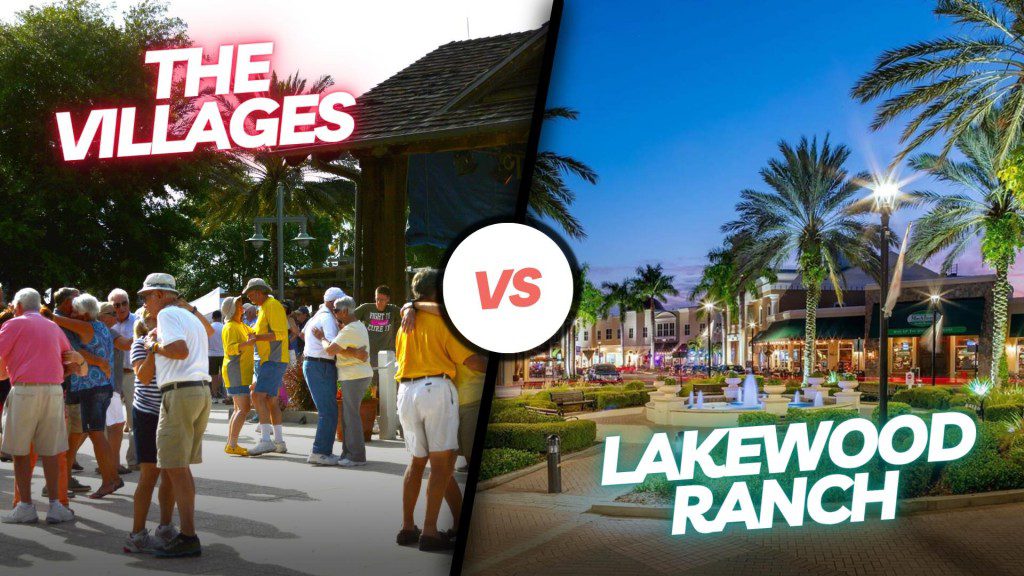
The Villages and Lakewood Ranch are both popular Florida communities — but built for completely different buyers. Here’s the honest breakdown on location, lifestyle, and cost.
Florida’s legislature just ended its session without putting property tax elimination on the ballot. Here’s what changed, what didn’t, and what it actually costs to own a home in Florida right now.