
The Florida housing market is one of the most misunderstood subjects online. Every day, buyers and sellers send me screenshots of dramatic headlines predicting foreclosures, collapses, and “the next 2008.” It’s no surprise—fear-based content spreads fast, and the loudest voices on social media rarely show the full picture.
But here’s the truth:
Headlines aren’t the market. Supply and demand is the market.
In this article, I’m going to break down the Florida housing market in a way the media never does—by looking at the actual fundamentals that drive prices, stability, and opportunity. If you want clarity instead of hype, you’re in the right place.
One of the biggest threats to smart real estate decisions today isn’t the market itself—it’s how the market is portrayed.
News outlets and content creators compete for attention, which means the story has to be dramatic enough to make you stop scrolling. A headline like “Tampa Becomes Foreclosure Epicenter” gets far more clicks than “Foreclosures Remain Historically Low Compared to 2008.” And once you engage with one negative story, algorithms make sure you see another, and another.
Pretty soon, it feels like everything in Florida is collapsing.
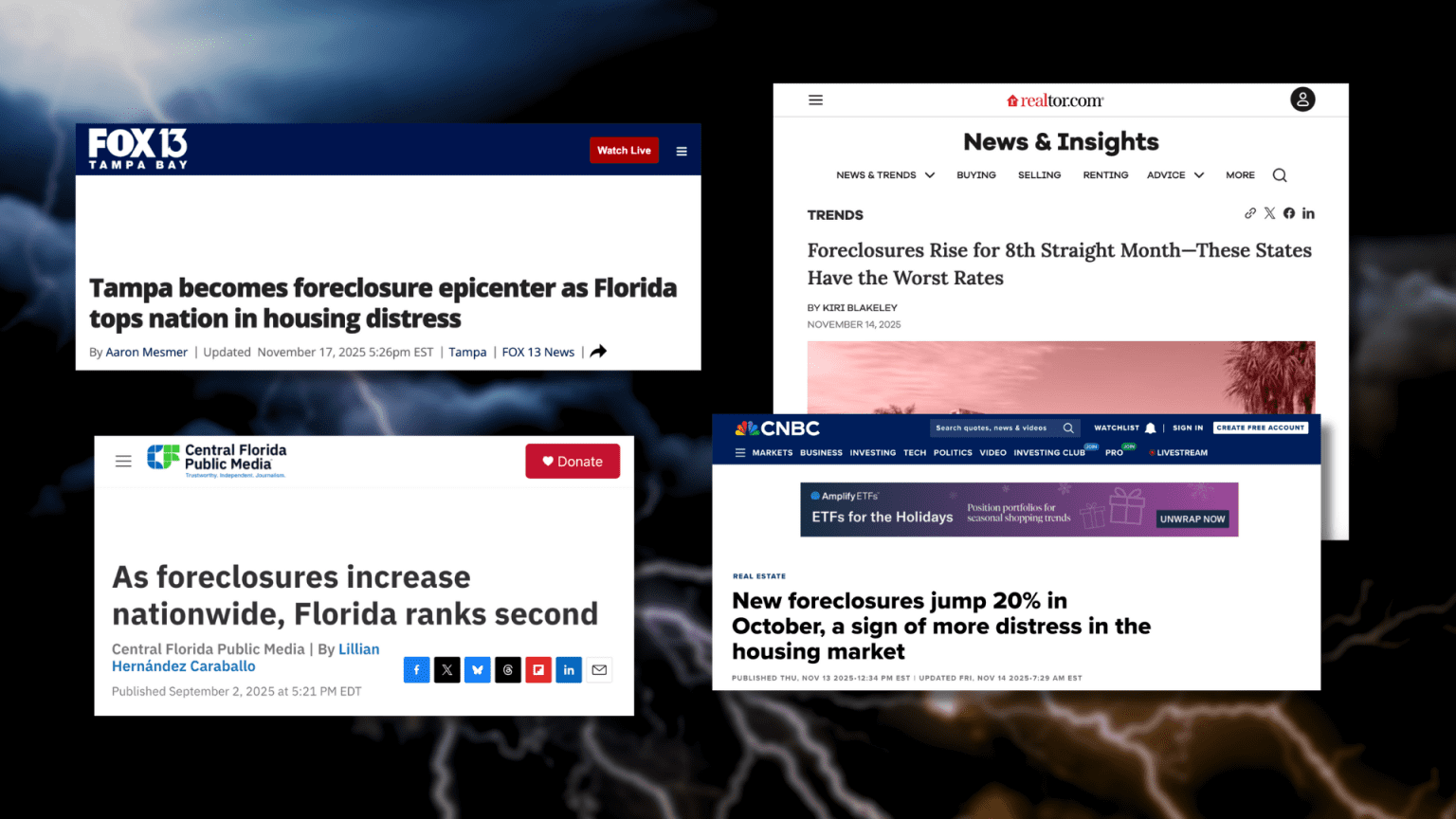
But when you actually read the data behind a typical doom-and-gloom story, the narrative falls apart. In the example above, the “epicenter” statistic was that 1 in every 1,373 homes in Tampa had a foreclosure filing. For context, during the 2008 crash, Florida saw foreclosure filings on 1 in every 22 homes.
There is simply no comparison.
And while Tampa Bay experienced major hurricanes recently—which understandably created hardship for some homeowners—localized storm impacts are not the same thing as a systemic market failure. The media rarely explains that. They keep the headline vague and dramatic, and people naturally assume the worst.
This is where most consumers fall into the trap of They making decisions based on emotion, not fundamentals. This causes many people to hold of on making decisions or even regretting moving to Florida.
That’s why understanding supply and demand is so powerful. It cuts through the noise every single time.
If you want the Florida housing market explained in the simplest possible terms, here it is:
Supply is how many homes are for sale and Demand is how many people want to buy them.
When supply is tight and demand is steady, prices firm up. When supply grows faster than demand, prices soften. Everything else – headlines, influencers, politics, interest rates—are layers on top of this basic equation.
The biggest mistake people make is treating the housing market like a national stock chart. Real estate is local. Extremely local. Even within one city, you can have multiple micro-markets moving in different directions. The key is how to determine which community is the best fit for you.
For example, Sarasota’s condo segment might soften at the same time single-family homes in Lakewood Ranch stay competitive. One area can feel slow while another is still seeing strong activity—because they have different levels of supply, different buyer profiles, and different incentives at play.
This is why national narratives almost always fail to describe what is actually happening on the ground in Florida.
If you want to understand the market the way professionals do, focus on months of inventory, also known as the absorption rate in real esate. It’s one of the most useful indicators to understand the market.
Here’s how it works:
You look at how many homes are for sale in a specific segment—say, single-family homes in Lakewood Ranch between $600,000 and $1 million. Then you look at how many of those homes sold last month. Divide the first number by the second, and you get the number of months it would take to sell all available homes at the current pace.
If the number is low, buyers have less to choose from and competition rises. If the number is high, buyers have more leverage and prices tend to flatten or soften.
Most balanced markets fall between four and six months of inventory.
Anything under that is considered a seller’s market.
Anything above seven months leans toward buyers.
Once you understand this one metric, you can interpret the Florida housing market more accurately than any headline will ever allow.
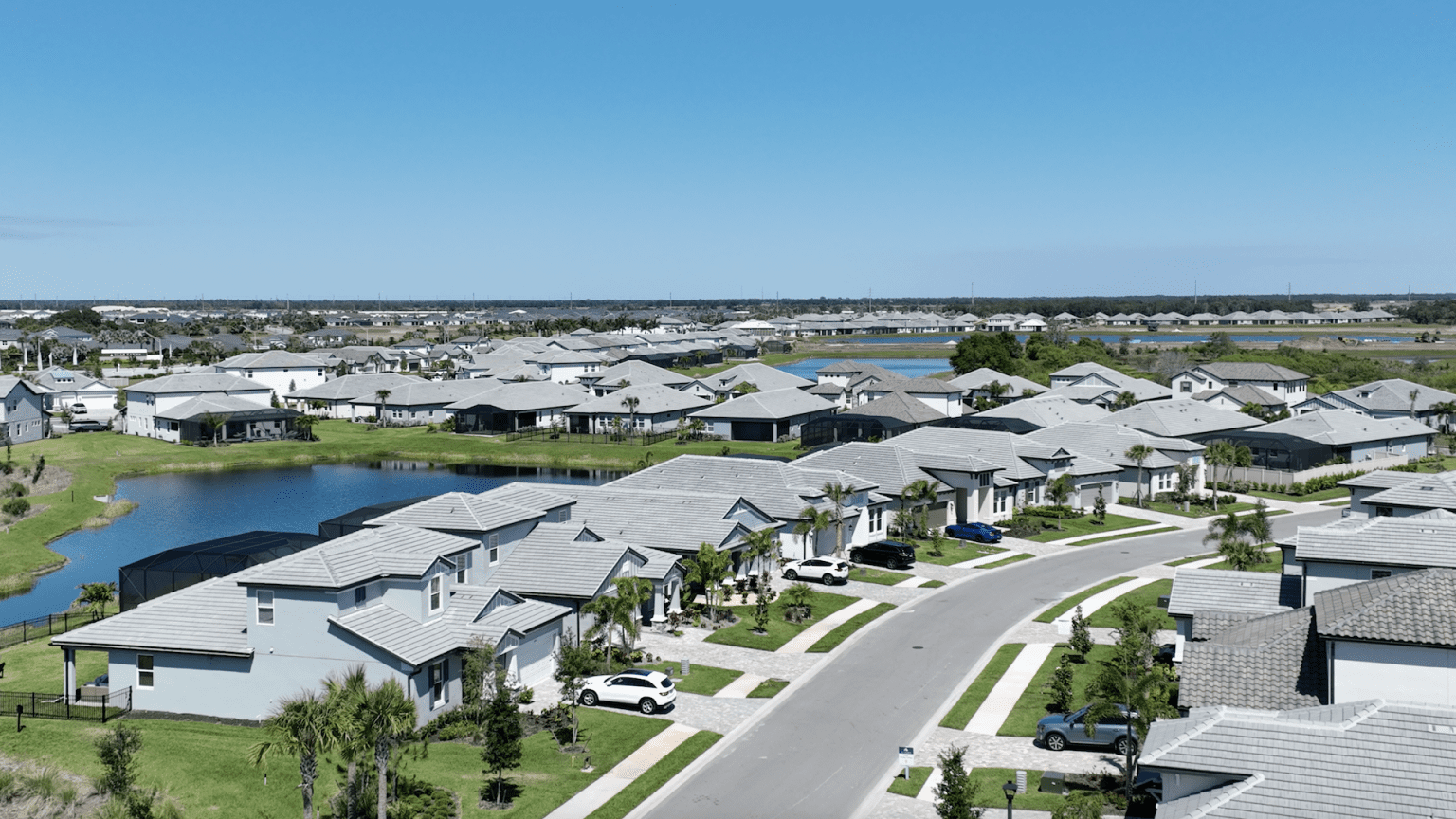
Supply in Florida doesn’t move the way it does in many other states, and this is a big part of the misunderstanding.
For one, many homeowners refinanced during the low-rate era of 2020–2021 and now hold mortgages in the 2–3% range. They’re in no rush to sell unless they absolutely have to. This “lock-in effect” keeps resale inventory lower than it would normally be.
On top of that, Sarasota and Manatee counties simply don’t have unlimited land. Even with new construction booming, builders cannot instantly add thousands of homes across every price point.
So when people assume “inventory will flood the market,” the reality is that—at least in most of coastal Florida—there are natural limits to how much new supply can appear quickly.
Add rising construction costs, stricter insurance guidelines, and labor shortages, and the supply pipeline remains slower and more constrained than headlines suggest.
Demand in Florida is shaped by long-term structural forces that don’t disappear because interest rates rise or the news cycle turns negative.
People continue moving to Florida for reasons deeper than price:
Warmer weather
Lower taxes
Better cost of living
Lifestyle communities
Safety and quality of life
Retiree migration
Job relocations
Remote work flexibility
To learn if Florida is right for you, check out the Top Pros and Cons of Living in Lakewood Ranch.
And Florida remains a destination for cash buyers—especially in the higher price points—who are far less sensitive to interest rate changes. This creates a baseline of demand that keeps the market more resilient than many people expect.
In other words, demand may cool in the short term, but it rarely collapses in Florida. People aren’t just buying homes here—they’re buying a lifestyle and a tax structure they can’t get elsewhere.
This is one of the biggest gaps I see between headlines and reality.
Many people believe Florida is on the brink of a dramatic correction. They expect prices to fall sharply, demand to evaporate, and inventory to spike. They assume 2008 is repeating itself because the headlines feel similar—even though the data looks nothing alike.
In reality, the Florida housing market in 2025 is best described as normalizing after an extreme period, not crashing.
Prices in some areas have flattened. In others, they’ve corrected modestly due to overbuilding in specific segments or shifting buyer sentiment. But nothing resembles the systemic mortgage crisis of 2008.
Long-term demand is still strong.
Inventory remains moderate in most areas.
And new construction, while active, still struggles to match demand in the most desirable communities.
This is why relying on supply and demand—not feelings—keeps you grounded.
Florida has structural advantages other markets simply don’t have. People move here voluntarily, often from higher-cost, higher-tax environments. They bring equity, cash, remote jobs, and retirement savings.
On top of that, Sarasota, Manatee County, and Lakewood Ranch offer something few regions can replicate: purpose-built lifestyle communities surrounded by beaches, golf courses, nature, and state-of-the-art amenities.
Even during periods of cooling, these communities attract buyers because they offer a level of quality of life other places can’t easily match. Unless something dramatic happens to Florida’s fundamentals, demand will remain strong relative to supply.
Buyers often fall into the trap of waiting for the perfect moment. But markets rarely deliver perfection—they deliver opportunities that make sense based on your goals, not headlines.
The smartest buyers today are those who focus on:
Understanding local supply and demand
Being prepared with financing
Looking beyond short-term rate fluctuations
You can refinance a mortgage when rates drop, but you can’t go back and buy yesterday’s price, in yesterday’s community.
For sellers, the market is no longer the frenzy of 2021—but it’s still strong in the right conditions.
Homes that show well, are priced correctly, and offer a clear lifestyle advantage continue to sell efficiently. Homes that are outdated or overpriced linger longer, especially when competing with pristine new construction.
The sellers who perform best are those who understand:
Pricing matters
Marketing matters
And competing with new construction requires strategy
Overpricing is the fastest way to lose momentum. Smart preparation is the fastest way to get strong offers.
No matter how dramatic the headlines get, the fundamentals of the Florida housing market haven’t changed. Demand for Florida living remains strong, supply is still limited in many high-appeal communities, and micro-markets continue to move at different speeds depending on location, lifestyle, and price point.
When you understand how supply and demand truly shape the market, you stop reacting to noise and start making decisions based on clarity and strategy — which is exactly how smart buyers and sellers win in Florida.
If you’re planning a move in Sarasota, Manatee County, or Lakewood Ranch, I can walk you through the supply and demand trends that matter most in your specific price point and community.
If you’re ready to start your search, book a free home buying strategy call.
Or learn more about all of our real estate services.